Showing posts with label Chon-Ji. Show all posts

Wednesday, December 9, 2020

Second e-book: Chon-Ji, Dan-Gun, and Do-San

It's out. Find it here: https://payhip.com/b/ipIF

What's in the book?

  • Over 65 application drawings
  • Complete applications (with drawings) for the first three ITF/Ch'ang Hon taekwondo patterns
  • An Introduction on the creation and structure of taekwondo patterns
  • Notes on applications for Heian Shodan, the kata that Chon-Ji and Dan-Gun are based on
Application for a section of pattern Dan-Gun

Finding a way to record all the applications I know has been a struggle, but I'm glad I could at least record them for three patterns (four with Sam-Il) complete with pictures. I thought about adding Won-Hyo into the book, but that would have taken more drawing. If you like the content on this blog, you will like the e-book. Enjoy!


Saturday, October 24, 2020

Second e-book on the way

About two years ago I published The Study of Sam-Il. It was fun to do a pattern that no one else had analyzed. The downside is that relatively few students know a 3rd-Dan pattern, so next I wanted to tackle some color belt forms.

I settled on starting right at the beginning. The name of the e-book will be 

Chon-Ji and Dan-Gun: Self-defense applications with notes on Heian Shodan.

What will be in the book?

Full applications with drawings for Chon-Ji and Dan-Gun. There will also be applications, but not full drawings, for the karate kata Heian Shodan/Pinan Nidan.

Beyond that, I may include an essay or two about pattern interpretation. I don't want to just repeat what was in The Study of Sam-Il, but given that this is about the first two ITF patterns some basic knowledge is warranted.

Where can I buy it

On Payhip, just like The Study of Sam-Il (which you can still purchase, by the way!)

When will it be finished?

Before the end of the year hopefully. The time-limiting factor is the drawings, but I have already finished the drawings for Chon-Ji. 

Application for the backwards stepping punch in Chon-Ji

Do these applications differ from Stuart Anslow's/ITF Radix/Anyone else's interpretation?

Yes, they are mostly unique; I do not believe I am just repeating someone else's material. The applications are organized in a systematic way so that you can see the logical structure of the two patterns.

While The Study of Sam-Il is for advanced Taekwondoin, this e-book will be a suitable introduction to pattern applications for students of any rank.


Saturday, May 18, 2019

27. The ITF low block chamber

Last time I talked about the knifehand guarding block and the theory that originally it was the chambers of basic techniques that were the blocks. To show another example of this, let's look at the ITF/Ch'ang Hon low block chamber.

In Choi's 1959 book Tae Kwon Do Teaching Manual, the Shotokan karate low block chamber is used. But by 1965, the chamber had changed to the wrist-to-wrist position. Many ITF basic techniques -- including the rising block, backfist, and knifehand strike -- utilize this chamber.

In this chamber, the blocking tool sets up inside the pulling tool, with the fists oriented such that the back of the wrists can touch each other.
ITF Low block
The traditional use of this chamber is brush-grab-strike. Meaning:
  1. You do an initial parry against a linear attack with your front hand.
  2. You do a secondary parry with your back hand (parry-pass) and grab. This forms the chamber.
  3. Pull in the opponent's arm to your hip while you use your front hand as a strike.
For the ITF low block, the "strike" is a hammerfist to the groin. This may be done from inside or outside the opponent's arm (depending on whether you parry the attack outward or inward), although for the low block is it safer to perform from outside since you leave your head exposed.

Source: Maul565
Source: Ryan Parker
What about if you parry the arm outward? From here a different strike, such as the backfist or knifehand to the neck, is preferable. ITF uses the same chamber for these two techniques.

In this 1956 taekwondo demonstration, we see both the chamber and pulling hand utilized. Source: hapkist
Other Applications

The chamber could also be used as a flinch block against a swinging attack. Since the pulling hand is on the outside, it can catch the opponent's arm and pull as your strike. This application is similar to the above gif where a punch is deflected outward.

The ITF rising block also uses this chamber. For two consecutive rising blocks, the chamber may be used to create a rudimentary figure-four lock. The application goes like this:
  1. Use the first rising block to block an attack or raise the opponent's arm
  2. Stepping forward, thread your other arm over the opponent's elbow as you grab their forearm with the blocking arm. This creates the chamber
  3. Circle behind the opponent and pull down their forearm (pulling hand) while lifting their elbow (second rising block), creating the lock.
Source: Nantanreikan Karate Dojo
From here you may walk forward or use a three-quarter turn (like in Dan-Gun and Do-San) as a throw.

Thursday, October 5, 2017

7: Chon-Ji sparring combinations

One unfortunate thing taekwondoin find about their forms is that most of the sets can't be used in sparring. ITF taekwondo sparring is kickboxing-lite, and you are not allowed to grab your opponent, but most forms are designed for grappling situations.

However, you can sometimes rework sets into combinations usable in sparring. Two examples of this are the sets from our white belt form, Chon-Ji.

  • Front stance low block
  • Front stance middle punch
And 
  • Back stance inner-forearm block
  • Front stance middle punch
Instead of treating these movements as one block followed by one strike, you can rework them into three strikes each.
Source: Advanced Karate Techniques
In the above image, the karateka uses the low block chamber (the karate version) as a simultaneous side parry and punch. He then follows with the hammerfist strike, and then steps forward with a jab.

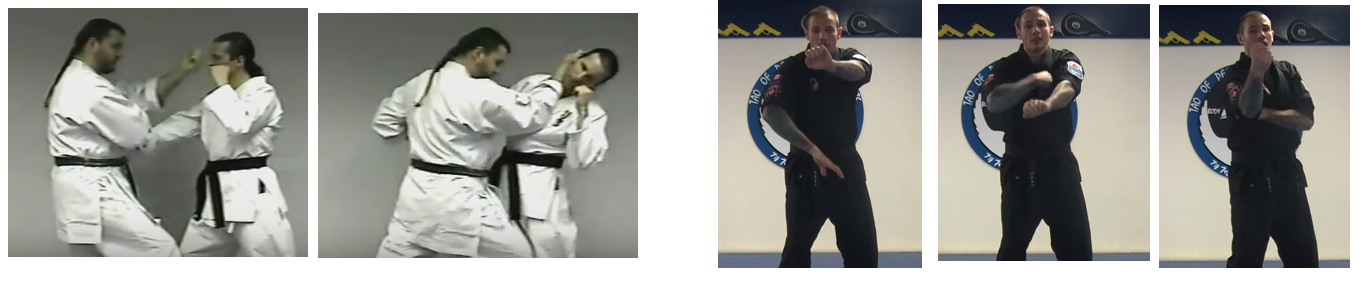
Below, Ryan Parker applies the inner-forearm block in a similar fashion. He uses the chamber as a down parry and punch, and then follows with the block-proper as a strike to the side of the neck. Personally I find that in sparring the motion works better as a rolling backfist to the face. Just like with the low block, after the two strikes you follow with a step forward and jab.
(Left) Inner-forearm block as two strikes. Source: Ryan Parker.
 (Right) A rolling backfist. Source: Tao of Peace Martial Arts
So to recap, the two striking sets are:
  1. Simultaneous side parry with front hand and punch with back hand
  2. Low hammerfist
  3. Step forward and jab
And
  1. Simultaneous down parry with front hand and punch with back hand
  2. Rolling backfist to face
  3. Step forward and jab
You can work this into a simple shadow boxing drill. Practice the first combination. Then, since you stepped forward for the jab, repeat on the other side. (This way you're also practicing a jab-cross). Now the do the second combination, and then repeat it on the other side. Practice switching between these two combinations so that you can pull them off quickly with muscle memory alone.

Defending a jab-cross

Another reason we chamber basic blocks to block two punches, not one. If your opponent throws a high jab-cross, for example, we can use the inner-forearm block against both punches. So the set would be as follows:
  1. Down parry jab while counter-punching (chamber)
  2. Deflect cross outward (inner-forearm block)
  3. Step forward with your own jab-cross
Jab-crosses are commonly thrown as different levels, so if your opponent throws a high jab-low cross, then you may perform the low block as the second defense instead.

Monday, July 10, 2017

Hae Sul 2: Gae-Baek drop takedown

In General Choi's books the double arc hand block is portrayed as catching a frisbee or throw pillow -- something that got a chuckle out of me the first time I saw it. Here I'll analyze the first time the movement appears in Gae-Baek and get something else out of it. The set is:
  • Front stance rising block 
  • Maintaining stance, low block
  • Maintaining stance, double arc hand block
  • Lift and bring in front foot to bending ready stance A
Of note, this is the first time in the ITF forms that a bending ready stance is not followed by a kick. In my club we tend to turn an extra 45-degrees as we perform the stance, in preparation for move 9.

A common interpretation for the last two moves is a two-handed "push" followed by a sweep. To avoid retreading old ground here's a different application, shown in the combined gif below:
Sources: One Minute Bunkai, Maul565
Details:
  • Assume an opponent grabs you. Use the rising block as an upward strike to their jaw (not in the gif) as you grab a hold of their wrist with your reaction hand.
  • Use the low block to crank their arm
  • Continue the crank into the double arc hand block. The top arc hand strikes the opponent's jaw
  • You can use the bending ready stance as a knee strike to the back of the head, but the interpretation I like is stepping behind your opponent and dropping to one knee, throwing them to the ground.
There are a couple other uses for the rising block. In the form you move backwards into it: it could be that your opponent is doing a grab-and-punch to the head and you are defending (a rising block, properly used, makes a good round punch defense). Another option is that your opponent is doing a double grab, and the rising block is breaking one of the grabs. Something similar is shown in the images below.
Left: rising block against a round punch. Right: rising block and low block against a double grab.
Sources: KDCombat System, Richard Moon
Edit 10-11-2017: For another, similar application, I recently stumbled across Paul O'Leary's old blog. You can read his application for the set here.