Friday, September 7, 2018

21. Toi-Gye "pushing block" mystery


Step 19 of Toi-Gye is not a guarding block. It is officially a "low double forearm pushing block". This motion is weird for a few reasons:
  • The only other kind of "pushing block" is the palm pushing block, which like its name suggests to meant to push the opponent with the palm.
  • This movement appears in no other ITF patterns. It is unique to Toi-Gye.
  • Despite the stated purpose of a "pushing block" being to push the opponent off balance, the only application we ever see for this motion is blocking a kick.
  • Similar motions used to push down an opponent -- such as the low knifehand guarding block -- are usually open-handed. Why the closed fists? And why is the inner-forearm used to block?
I wanted to see where this movement came from. In General Choi's 1965 book Taekwon-Do: The Art of Self-Defense, he lists instructions for several karate kata in addition to the original 20 ITF patterns. The low forearm pushing block appears in two kata: step 10 of Gankaku (which Gen. Choi calls "Ro-Hai" for some reason) and steps 10 and 27 of Tekki Sandan. I looked up youtube performances of the patterns and compared the "pushing blocks".
(Left) Low forearm "pushing blocks" from Toi Gye (left), Genkaku (Middle), and Tekki Sandan (Right). Source: Shotokan Sensei
Neither of these motions look like Toi-Gye. In Genkaku the outer-forearm is used. In Tekki-Sandan the inner-forearm is used, but it's in riding stance and the position of the back arm differs. So as far as I can tell, the motion is unique to Toi-Gye.

Application?

Here I suggest that the use of the name "pushing block" is literal. I know it's common for bunkai researchers to say that the name of the block means nothing, but when a unique motion is used with a unique name, I think we can make an exception

Specifically, we use the pushing block to create a rear wrist lock, a police hold that appears in the Encyclopedia of Taekwon-Do (Volume 5, page 313). We follow with a knee strike to the opponent's lowered head, and then a throw via a head crank.

We begin with the counter-clockwise turning W-block (mountain block), using it to create an armbar.
Source: CentralMichiganTKD
Notice how the tori lands his front leg in front of his opponent's right leg. This is important: we are setting up a trip. The armbar should be a forceful one, utilizing the 180-degree swing we perform in the pattern. This will knock the opponent's shoulder forwards.

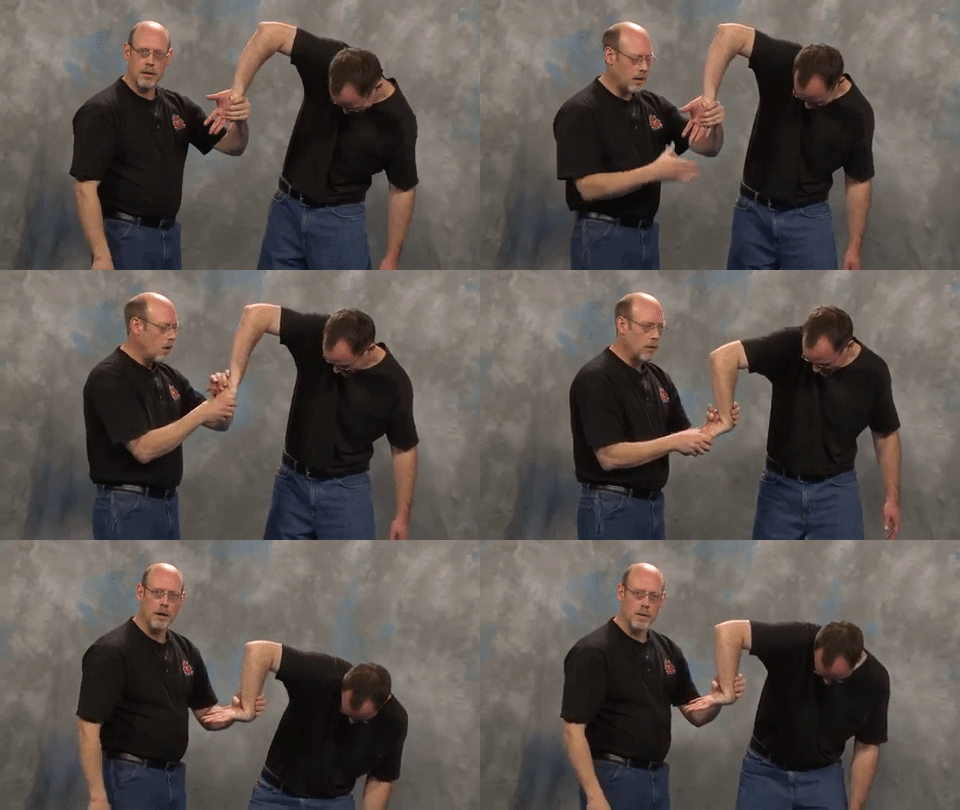
As you step in with your left leg, bend your opponent's arm such that their elbow is up, as in a hammerlock. Now you will switch hand positions: grab their left knifehand with your right hand. As you maneuver your arm into the low inner-forearm block, you will naturally curl your opponent's hand and bend their fingers in towards their inner elbow. Make sure to bend their arm behind their back, and grab their elbow with your right hand for control. This creates the rear wrist lock.

(Left) How the low inner-forearm block turns the opponent's wrist. You may bend their fingers towards their elbow. (Right) The rear wrist lock, although the grip in this case is different. Source: Bertoni Defense Systems
Bending the opponent's wrist in causes them to reflexively bend forwards, so you can use both fists to literally push them forwards and to the ground. The direction of the wrist actually pushes them down to the right (towards their elbow), and so when combined with the trip they may fall onto one knee.

If they don't fall, follow the pattern: grab the back of their head with both hands and knee strike their face. Then grab the head with both palms (left hand underneath, right hand on top) and crank it as you turn around into the knifehand guarding block [1], attempting to flip and throw the opponent by their head.

A wrist lock application might seem too esoteric for some, but this is application that both (1) follows the pattern and (2) explains why it is called a "pushing block". This lock also appears in the Encyclopedia of Taekwon-Do, so I'm not pulling it out of nowhere.


[1] A head crank is a common application for the knifehand guarding block. If you move your two palms closer together, then moving from the setup to the block-proper mimicks grabbing and cranking the head.

Wednesday, September 5, 2018

20. Choi-Yong double kick


Steps 13-14/18-19 of Choi-Yong comprise of a "reverse hooking kick" (more commonly known as a spinning hook kick [1]) followed by a side kick without putting the foot down. It's challenging to perform due to the balance it requires. But it is all flash or does it have an application?

In my last post I described how the previous set comprises a single leg pick and leg twist. We use this set if the leg twist fails. Why a double kick? Let's change the turning hook kick to a back leg hook kick and you might see what the technique represents.

Source: ProJudo
The hook kick is just hooking around the opponent's standing leg, and the side kick is reaping it backwards, allowing us to push the opponent to the floor. I believe this is the basic idea behind the hook kick, side kick combo.

But why a spinning hook kick?

In my opinion, the spin is used to (1) pull the opponent off-balance, which makes the reap easier, and (2) switch to an inside leg position if we are not in one already. Spinning while pulling the leg will drag your opponent around 180-degrees. You may also use the pull as an opportunity to move the opponent's ankle outside your body. Hook around their standing leg and reap back.


[1] There are actually two similar kicks in ITF taekwondo that a layman would call a spinning hook: the reverse turning kick and the reverse hooking kick. The difference is that the former is intended purely as a strike with the heel, and the leg remains more-or-less straight. The reverse hooking kick, however, folds at the knee while you kick as if you are hooking around something.

Sunday, September 2, 2018

19: Choi-Yong leg twist


A while back on a Taekwondo facebook group, someone mentioned the double kick in Choi-Yong as a technique they had difficulty finding an application for. I have an application in mind, but before I can explain it I must explain the application for the previous set. The set is:
  • Front stance knifehand rising block
  • In place, circular block
  • In place, front hand punch
  • Turn 180-degrees into back stance low knifehand guarding block
  • Back leg roundhouse kick, aimed off at 45-degrees
We use this set as a single leg pick, followed by a leg twist as we get behind our opponent. The rising block we use to knock our opponent backwards, perhaps striking up under the jaw, after which we grab and lift their leg with the circular block. A modern version of this technique used in wrestling is to use one palm as a "post" to keep the opponent back while we scoop up their leg.
Post and leg pick. Source: Effective Martial Arts

After scooping up their leg with the circular block, grab their knee with your back hand and their ankle with your front hand. Use the "punch" to pull back their knee while you push out their ankle, pronating their leg.

To complete the leg twist, turn 180-degrees and use the low knifehand guarding block to dig down into the opponent's knee. Your back arm hugs their ankle to your chest.This application is displayed in the gif from One Minute Bunkai below.
Source: One Minute Bunkai
Note that in Choi-Yong we do a 180-degree turn as we twist their leg, making it easier to get behind them. We end with a roundhouse kick to the back of the opponent's standing leg. (45-degree roundhouse kicks usually indicate kicking in the back of the legs).

This leg twist seems rather common in both taekwondo patterns and karate kata. The trouble is that it often doesn't work against a stronger, heavier opponent. In the next post, I'll cover an alternate single leg takedown from Choi-Yong.

Tuesday, August 28, 2018

18. Ul-Ji second set


For the second set in Ul-Ji, we perform a double X-block combination. This combination originally comes from the kata Heian Godan, where its standard explanation is to block a kick and then block a punch. But it has several other hidden applications to explore. The set is:
  • Left front stance X-fist pressing block
  • In place, X-knifehand rising block
  • In place, right hand inward knifehand strike, placing left palm on right inner-elbow
Here we begin from the opening technique described in the previous post. Now we assume that the technique didn't work; we still have a hold of the opponent's left arm with our left fist, but their head is free. To prevent the opponent from turning towards us, we step backwards again and pull down their left arm. At the same time, we push down their left shoulder with our right fist. This creates the X-fist pressing block.

Doodle of the technique
Steps 2 and 3 in the above diagram are down simultaneously in the pattern, but I break them down here so you can see the technique. After pushing down the opponent's left shoulder, wrap your right arm under it and lift. This creates a hammer lock. At the same time, slap across the opponent's face with your left rising knifehand. Besides being a distracting strike to our opponent, this also turns their face away from you, exposing the back of their neck. Notice how the right arm stays on top of the left in both X-block techniques.

Finally, with the back of their neck exposed, we finish with an inward strike. This should knockout your opponent. Your left palm comes back to over your opponent's left shoulder for control. Although the set ends with the inward strike, from here you can strengthen the shoulder lock using both palms to push the shoulder down, and then spin to take the opponent to the floor if they are not knocked out.

Sunday, August 19, 2018

17: Ul-Ji opening

Ul-Ji has a unique ready position. It has no formal name, and to my knowledge appears in no other taekwondo pattern or karate kata. Combined with the two opening moves it comprises a simple application: a reverse head throw.

Source: Funker Tactical
The motion begins from a cross-hands position. You then grab the arm or shoulder of the opponent with one fist and their face your the other fist. Step backwards and forcefully uncross your arms, forcing the opponent to turn around. From here, pull them to the floor. The position of the hands in Ul-Ji suggests that we are grabbing under their triceps, specifically their left triceps, meaning we grab their face with our right fist. The opponent may escape this throw by ducking their head under our grip, in which case we follow with other sets from Ul-Ji.

Those of you who have studied patterns might note that this technique can be represented in other ways, usually with the standard low block. Another technique which often represents this throw is the "low opening block", what in ITF is called "Closed Ready Stance D" in Eui-Am. In fact, the ending of Eui-Am can represent the same throw.
Application for ending of Eui-Am.
Image sources:ITF Radix, Funker Tactical


This throw also exists in Silat, where it is called tarik kepala.


Monday, May 21, 2018

eBook released: The Study of Sam-Il

The eBook is now available for purchase in PDF form at PayHip.

https://payhip.com/b/DHeM

You may purchase with either PayPal or Credit/Debit.

Book description:

Fighting applications for the Ch'ang Hon/ITF taekwondo pattern Sam-Il. Contains:
  • Over 70 application drawings
  • Analysis of both the 1965 and 1983 versions of the pattern
  • Explanation of Sam-Il's logical structure; i.e. how all the sets tie together
  • Insights on the design of the Ch'ang Hon patterns
Enjoy!

Tuesday, May 15, 2018

16: Sipjin wristlock

Source: TaekwonWoo
Today I'm writing about a set from a Kukkiwon poomsae, Sipjin. This is out of personal interest: it's the only example of a spiral wrist lock (called sankyo in Aikido) I've found in a taekwondo form. The set is:
  • 1: Bull block (double rising block)
  • 2a: Pull fists away from each other
  • 2b: Right back stance left augmented outward block (inner-forearm block), right palm touching left forearm
  • 3a: Slowly open the left fist and turn it inward. Slide left foot to shift into left front stance
  • 3b: Right horizonal fingertip strike
  • 3c: Left hand punch
  • 3d: Right hand punch

The opening of Sipjin may be used as a rear bear hug quick escape. Lift both arms to loosen the opponent's grip, pulling their hands apart (step 2a) if necessary. This escape is commonly taught in self-defense sets, although it's usually accompanied with dropping one's weight into riding stance.
Source: Overland Park Karate
But if the opponent gets a secure grip, this quick escape is unlikely to work, so Sipjin contains other options. The first of these is the sankyo lock. This can be obtained by gripping the knifehand of the opponent (either their right knifehand with your left hand, or their left knifehand with your right hand) and then slipping under one of their arms, granting you the wrist lock.
Getting a sankyo lock from a rear bear hug. Source: ExpertVillage
Step 2b, the "augmented block", encodes the wrist lock. Here the primary "blocking" hand grips the opponent's right knifehand, twisting their wrist, while the supporting palm grabs their fingers.

The next movement in the set is the mysterious hand turn. We use this to transition from sankyo to a thumb lock. Doing this allows us to twist the opponent's arm even more as we pull our left fist to our hip for step 3a, causing them to lower their shoulder as you pull back their thumb. To aid this, you also push down their shoulder with the open-handed strike (step 3b)

Left: Sankyo to thumb lock. Right: Application for the horizontal fingertip thrust

Source: StaySafeMedia

Follow with two punches (steps 3b and 3c) to the back of the head.

A variant is to use your left thumb to push in the back of the opponent's wrist instead, rather than hook their thumb, but when practicing with a student we found that the thumb lock allows more control via pain compliance.

Now, wrist locks in a taekwondo form might seem like a stretch to some people. Is there any historical evidence that taekwondoin would put wrist locks into their forms?

Source: Sihak Henry Cho's 1969 book Self Defense Karate
Oh, look, a very similar lock from a 1969 taekwondo manual. The difference is that the hands are switched.

Joint locks in early taekwondo are old news. It's hard to realize now, but taekwondo was originally founded as a mixed martial art, incorporated both throwing and locking techniques. Ørjan Nilsen over at Traditional Taekwondo Ramblings has a great post on this called Taekwondo and Joint Locks: A Historical Journey. The core art is still striking. Notice how the point of the lock in Sipjin is to get to the back of the opponent's head, which we then punch.

Although taekwondo's locking and throwing techniques are no longer commonly taught, they were preserved in the forms. Finding the techniques is the way to resurrect these old ideas and increase our understanding of the art.

In other news, The Study of Sam-Il is almost finished. I'm adding a few more drawings.