Friday, October 4, 2019

32. Something strange about Ilyeo

In past articles I've written that if you want to know a pattern's original intent, it's important to study earlier versions. The ITF patterns have changed in subtle ways between General Choi's 1965 book and his 1983 Encyclopedia of Taekwon-Do; most of these changes have been compiled by Matt Gibb. But the kukki-taekwondo patterns appear to have changed as well. By happenstance I came across some changes to the 9th-dan poomsae Ilyeo. You can view a video of the form below:


The strange thing about Ilyeo is its asymmetry. Movements are repeated, but on the same side. The diamond block in right back stance (R.B.S.) is performed four times in total. The only symmetric set is the front kick followed by the flying side kick at the end of the pattern. This is strange since all the Kukkiwon patterns, except the Original Koryo, are symmetric.

Anyway, Ilyeo includes a weird stance called "reverse crane stance" (ogeum seogi). It comes from the kata Chinte and is also found in the ITF pattern Se-Jong. It is performed by raising one foot behind the knee of the standing leg. 
Source: Blue Dragon TKD
I noticed that videos of Ilyeo differ in the hand motions during the stance. Some utilize a right spearhand thrust, others a left. Some use one and then the other -- since the stance occurs twice in the form -- but not always in the same order.
Source: Sejong Taekwondo Dojang
Confused as to which version is correct, I askedof Traditional Taekwondo Ramblings to look up older versions of the pattern for me. He sent me the 1975 version (from Taekwondo Poomse by the World Taekwondo Federation) and the 1986 version (from Tae Kwon Do Textbook Vol III by Kim Jeong-Rok).

According to the 1986 version, for the first crane stance a left spearhand is used, while for the second a right spearhand is used. These instructions match the video above, although in some older videos the opposite is true.

But there's something different about the 1986 version: the fourth diamond block is in a left back stance (L.B.S.). You do a three-quarters turn into it after a left hand punch.

In this version of Ilyeo, the first front kick is performed with the left leg, whereas in the modern version the first front kick is with the right leg.

If you travel further back in time to the 1975 version, the text instructions are symmetric. At least, movements are performed equally on both sides (with the exception of move 1). So the diamond block is performed twice in R.B.S. and twice in L.B.S. In this version of the pattern, the spearhand is always performed on the side of the raised leg, but you perform once on either leg.


There is some ambiguity because the images in the 1975 book don't match the text instructions. Case in point: even though the text says that the second side kick should be with the right leg, in the image you see the left leg used.


Nonetheless, text instructions for a symmetric Ilyeo exist, and that makes sense given the other poomsae are symmetric. This begs the question: why was the poomsae changed? Why are the two spearhands mirrored when the stances are not? The original name of the pattern was Silla, after the ancient Korean kingdom. It was later changed to Ilyeo, a Buddhist term meaning "oneness". From the taekwondo wiki:
일여 (ilyeo) refers to the Buddhist concept of oneness of the mind and body, the immaterial and material. The form therefore represents the oneness of mind and body achieved through training, and thus it represents the essence of martial arts. Stemming from Buddhism, the goal of spiritual life is Ilyo, oneness or nirvana. Only in this state is ego overcome. The ideal of taekwondo is Ilyo. It is a discipline in which you concentrate your attention on every movement and in doing so, shed all worldly thoughts and preconceptions.
funikoshi4.png
Funakoshi's "Neck Ring"
throw
Perhaps the repetition in modern Ilyeo is intentional, like a Buddhist mantra. I personally prefer the symmetric version, however.

The Reverse Crane Stance

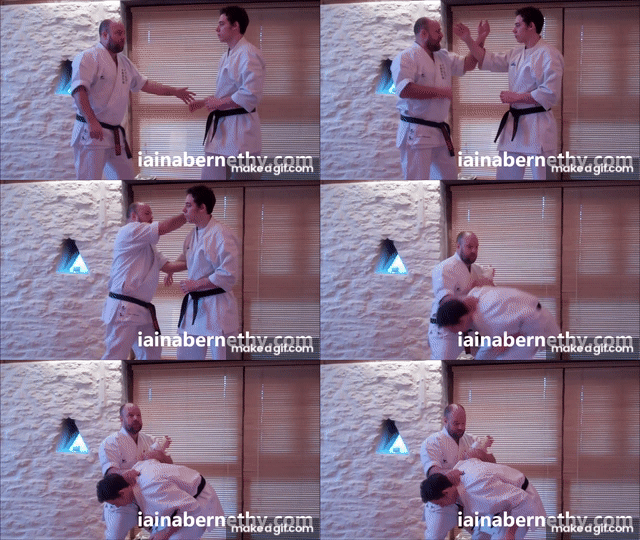
One of the applications of the supported spearhand is a throw where the head is hooked (spearhand) and the small of the opponent's back is pressed inwards (supporting hand). The leap forward in Ilyeo can aid this throw. So what is the use of the reverse crane stance?

In the case of the left spearhand, which appears to be the original version, you can perform a leg hook, called a "ko uchi gake" in Judo. It's an unusual throw for a taekwondo form, but then again the stance itself is unusual.
Source: moncoachjudo

Friday, September 27, 2019

31. Gae-Baek first nine-shape-block and flying side kick

Gae-Baek is the favorite pattern of many ITF students, and its unusual movements invite close analysis. Here is an application for the set including the first nine-shape-block and the flying side kick. The whole set is:
  • 19: Right back stance knifehand guarding block
  • 20: Shift left foot slightly right into riding stance nine-shape-block (left arm high)
  • 21: Keeping left foot planted, turn counter-clockwise 270-degrees into front stance low knifehand block
  • 22: Back leg roundhouse kick, aimed at 45-degrees
  • 23: Flying side kick with the same (right) leg.
It's typical to teach the nine-shape-block as an elbow break, but that doesn't fit the context of the form. Instead, there are other arm locks the nine-shape-block could represent. After using the guarding block as an overhook and neck press, we can setup a hammerlock on the same arm.

Nine-shape-block as a hammerlock, two variations. Image source: Practical Kata Bunkai (top), Sidewinder JiuJitsu (bottom)
Shown above are two variations: one with the left arm pulling the triceps from underneath, the other with the left arm overhook the opponent's triceps (the "Kimura"). Either variation may be used to create a hammerlock.

Having set up the lock, we use the counter-clockwise turn to get behind the opponent. This lock will force them to bend forwards, so we use the knifehand low block as a strike to the back of their neck. It's possible to use this block to push down the opponent's shoulder instead. But having already created a shoulder lock, it seems more parsimonious to simply strike the opponent.

The two kicks

From behind the opponent, kick in the back of both legs with the roundhouse kick. Here you may see why the kick is aimed at 45-degrees (an odd instruction): that's where the opponent's legs are located! This kick will topple your opponent forwards. Finish with the flying side kick as a drop kick to the back of the head.

This double-kick strategy -- one kick to the legs and the second kick to the head -- may exist in other patterns. Koryo for example. The Kukkiwon poomsae Ilyeo features a flying side kick after a front kick, and may have a similar application.

Friday, September 20, 2019

30. Eui-Am 5 move set


It's my belief that the five move set from Eui-Am encodes two follow up techniques after using the wedging block against an attack. The set is:
  • Front stance knifehand wedging block
  • In place, open-handed circular block 
  • Bring front foot back into cat stance twin palm downward block
  • Shift front foot into back stance reverse punch
  • Slide backwards into back stance low inward ridgehand block, bringing back arm into chest
The first technique will use an unconventional application of the circular block: an arm lock:

Source: Martial Gamer

Block a left handed attack with your right leg forward. Use the long arc of the circular block to wrap over the opponent's elbow while you pull their forearm down with your reaction hand. Doing this with enough pressure will injure the opponent's shoulder.

The finishing move the form provides is the cat stance twin palm downward block. Because this lock forces the opponent to lean left, the cat stance is probably meant to trap their left leg. You may then use your two palms to push the opponent's face to the floor.

For the next technique we will still utilize the wedging block with the right leg forward, but this time against a right handed attack. From this position, our right hand is pushing on the opponent's neck. Grab their head and pull it downwards (pulling hand) while you either grab or underhook their right arm (reverse punch). We finish with a puter kepala throw, also known as "the clock" takedown. This is performed by sliding backwards while pulling the opponent's arm and pushing their head in.

Source: Craig Gray
Eui-Am is noteworthy for being the first of the "new" forms, not one of the original 20. Some ITF-schools do not teach these forms, for fear that they were made to be challenging to perform and do not have the self-defense value the original 20 do. But I find the movements in these forms have both applications and a logical arrangement behind them.


Monday, September 9, 2019

29. Gae-Baek opening


In Gae-Baek we open by stepping backwards into an X-knifehand checking block. (Notably, this is the first form that opens with a step back). The "official" explanation for the checking block is that we are blocking a punch.

Encyclopedia of Taekwon-Do, Vol 11
There are a couple problems with this application. Why block with two hands when one will do? The wrist twist presented is not in the form. What if we applied this a little differently?

Source: One Minute Bunkai
By deflecting with one arm (the right forearm), we can use the left forearm to chop down on the opponent's elbow, creating a figure-for lock. A straight punch may be too fast for you to apply this technique, but this will also work against a lapel grab.

This technique is a shoulder-lock and will force the opponent to bend towards their right. We follow with the low twisting kick to their right knee, unbalancing them. We finish with the landing into the front stance "punch" as a takedown: pull the opponent down over your right leg with your left hand as you push with your right hand.

Example of a twisting kick to the knee after a figure-four lock
Follow with the second punch to your downed opponent before retreating.

Saturday, June 15, 2019

28. Striking targets for middle knuckle punch

The use of gloves in combat sports has led to the exclusive use of closed fists as a hand striking tool. But in bareknuckle fighting, striking with the front fist is risky due to the chance of breaking your small finger bones on the opponent's skull. This is why, in my opinion, most punches in TMA forms are aimed at the rib or solar plexus level, while the head is reserved for other hand strikes. Bareknuckle boxing manuals also note the problem of punching with an unprotected fist, which is why the backfist ("chopper") was a favored tool to mix in with punches.

TMAs contain a number of hand strikes outside of punches and backfists. These include the:
  • Knifehand
  • Palm heel
  • Hammerfist
  • Longfist
  • Arc hand
  • Spearhand 
  • Ridgehand
  • Two-finger poke
  • Bow wrist 
  • Index knuckle (as seen in Choong-Jang) [1]
  • Middle knuckle

The latter shows up in Gae-Baek, Choi-Yong, So-San, and the KTA poomsae Cheonkwon. It is performed either straight out or upwards like an uppercut.


The important thing to know about this strike is that it is not meant to be aimed at the throat or jaw, even though that's how it may look in the above mentioned forms. Rather, the middle knuckle fist is traditionally aimed at small, vital spots such as the temple, solar plexus, philtrum (small area between the mouth and the nose), side of the neck, and the armpit.

(Left): American Kempo-ist demonstrating middle knuckle strike to armpit. Source: casadekenpo (Right) Vital point diagram from The Encyclopedia of Taekwon-Do.


Yes, really, the armpit. There is a nerve cluster there that you can find on yourself by striking lightly with your middle knuckle. You should feel a tingly sensation when you hit. Supposedly striking this hard enough will deaden the whole arm. In Gae-Baek this allows you to use the next movement -- the nine-shape block -- as an armlock without resistance. The double knuckle fist uppercut in Cheonkwon is likely aimed at the armpits as well, perhaps as a defense against a double grab.

What about the straight knuckle punch in Choi-Yong? Here I don't prefer the philtrum as a target because while it may push away the opponent, is it unlikely to end the fight. We can use the previous movement in the form -- cat stance forearm guarding block -- as an armlock to turn the opponent. This exposes the side of their neck for a knuckle fist strike. Another possible target is the temple, though this is smaller and thus harder to hit.

David Gimberline demonstrating a strike to the side of the neck. Source: Shuhari Institute
Alternatively, the guarding block might be a push as you trap the opponent's leg with the cat stance. You then grab and pull in their opposite arm, turning them, as you strike the side of their neck.


[1] The twin index knuckle fist in Choong-Jang is aimed at the opponent's temples. Presumably the index knuckle gives you more motor control to dig in.

Saturday, May 18, 2019

27. The ITF low block chamber

Last time I talked about the knifehand guarding block and the theory that originally it was the chambers of basic techniques that were the blocks. To show another example of this, let's look at the ITF/Ch'ang Hon low block chamber.

In Choi's 1959 book Tae Kwon Do Teaching Manual, the Shotokan karate low block chamber is used. But by 1965, the chamber had changed to the wrist-to-wrist position. Many ITF basic techniques -- including the rising block, backfist, and knifehand strike -- utilize this chamber.

In this chamber, the blocking tool sets up inside the pulling tool, with the fists oriented such that the back of the wrists can touch each other.
ITF Low block
The traditional use of this chamber is brush-grab-strike. Meaning:
  1. You do an initial parry against a linear attack with your front hand.
  2. You do a secondary parry with your back hand (parry-pass) and grab. This forms the chamber.
  3. Pull in the opponent's arm to your hip while you use your front hand as a strike.
For the ITF low block, the "strike" is a hammerfist to the groin. This may be done from inside or outside the opponent's arm (depending on whether you parry the attack outward or inward), although for the low block is it safer to perform from outside since you leave your head exposed.

Source: Maul565
Source: Ryan Parker
What about if you parry the arm outward? From here a different strike, such as the backfist or knifehand to the neck, is preferable. ITF uses the same chamber for these two techniques.

In this 1956 taekwondo demonstration, we see both the chamber and pulling hand utilized. Source: hapkist
Other Applications

The chamber could also be used as a flinch block against a swinging attack. Since the pulling hand is on the outside, it can catch the opponent's arm and pull as your strike. This application is similar to the above gif where a punch is deflected outward.

The ITF rising block also uses this chamber. For two consecutive rising blocks, the chamber may be used to create a rudimentary figure-four lock. The application goes like this:
  1. Use the first rising block to block an attack or raise the opponent's arm
  2. Stepping forward, thread your other arm over the opponent's elbow as you grab their forearm with the blocking arm. This creates the chamber
  3. Circle behind the opponent and pull down their forearm (pulling hand) while lifting their elbow (second rising block), creating the lock.
Source: Nantanreikan Karate Dojo
From here you may walk forward or use a three-quarter turn (like in Dan-Gun and Do-San) as a throw.

Saturday, May 4, 2019

26. The original guarding block chamber

Many schools, I've noticed, practice a variant of the guarding block chamber. Some shoot both arms straight back before moving them forward. Others begin with their hands down near their hips.

The original way to perform the guarding block, as shown in General Choi's books, is to begin with the back hand high, near the ear, and the the front hand at blocking level, such that it moves in a horizontal line when executing the block.

Guarding block from Taekwon-Do: The Art of Self-Defense (1965) and The Encyclopedia of Taekwon-Do 2nd Ed (1987)
Why bring up this minor point? Because originally it was the chambers that were the "blocks", not the motions we today call blocks. The reason the back hand sets up near your ear is to defend against a haymaker. After this, you overhook the opponent's arm (back hand downward motion) and push out on their neck (front hand horizontal motion), preventing them from throwing another strike.
The traditional use of the guarding block in action. Source: CrossFit
A few things should be said about this application:

(1) This is a defensive technique, not a "strike". Although pressing on the side of the opponent's neck is uncomfortable, the purpose is to control the opponent until the situation de-escalates. If it does not, then there are several follow-ups from this position.

(2) The motion of the back hand is an overhook, not a pull. The purpose is to hold the opponent's arm in close to your chest to prevent them from attacking you further.

(3) Notice that when the application is executed, you are 90-degrees from your opponent. Hence while the chamber seems to be performed to your side, in reality it is performed in the direction of the haymaker.

Two other applications

The downward motion of the back hand has other uses. Another common application is an underhook, performed by making the movement more circular. You may simultaneously use the front knifehand to push the opponent's head forward. If you manage to place the opponent's forearm onto your shoulder, you can lock their elbow, creating what's call a standing ude gatame in Judo.

Underhook/ude gatame application for the guarding block. Source: PracticalKataBunkai
Like the overhook, there are several follow-ups from this position; Iain Abernethy shows a few in the linked video. The circular performance of the guarding block is also found in Choi's books, and in some karate styles such as Kyokushin.

The circular guarding block performance, from the Encyclopedia of Taekwon-Do Vol 3
The third application is a head crank, performed by bringing the two hands closer together. Working together, the movement of the two palms becomes a head twisting motion. The back hand begins high and then twists low, throwing the opponent by cranking their head.

Source: Jesse Enkamp
Another example by application researcher Richard Conceicao is here. This works well for the 180-degree turn into the guarding block in move 3 of Choong-Moo. In fact, all three of these applications are scattered throughout the Ch'ang Hon forms. Try looking for one the next time you spot a guarding block.

This post is an expansion on Ørjan Nilsen's article