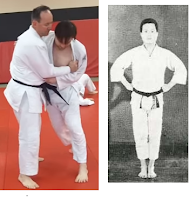
In my study of the ITF patterns, I've mainly restricted myself to the original 20. This is partly because the original 20 already contain a lot of material, and partly because they are more closely based on karate kata and thus easier to find applications for online. But it's also because I find the "newer" forms (Eui-Am, Yong-Gae, Moon-Moo, So-San, and Juche) difficult to interpret.
Moon-Moo
Take Moon-Moo for instance. There are some sections where I can kind of see what's going on. In the past I've discussed how the two palm pressing blocks followed by the one legged stance may be an arm drag followed by a restraining position.
 |
Stuart Anslow's application for steps 7-9 of Moon-Moo. Arm drag to control position (adding in a knee strike). Sources for bottom images: Karate Culture and Kinetic Dragon Kenpo
|
Similarly, the stepping side kick followed by the high spinning hook kick ("reverse turning kick" in ITF lingo) may be interpreted as a kick to the knee -- collapsing the opponent's leg -- followed by a blow to the back of the head.
 |
Right image from the Encyclopedia of Taekwon-Do
|
Not super practical, but you can see what's going on.
But most of Moon-Moo is still confusing to me. The beginning especially. Why two kicks followed by a middle spearfinger strike? This is unfortunate because the beginning of a form usually determines the applications of the following sets. Does that mean there are no applications? No, not necessarily. I like to give forms the benefit of the doubt. However, the primary function of these "newer" patterns was not to convey practical applications but to incorporate Taekwon-Do's more advanced techniques, particularly kicking techniques.
Eui-Am
 |
Stuart Anslow's application to steps 6-7 of Eui-Am from the Bubishi. Form performance by Joel Denis
|
Eui-Am was my least favorite form to practice. In particular I disliked the spinning kick that was aimed at 45-degrees, requiring you to stop the kick mid-way. The usual explanation for this is that it "trains balance". However if we look at other patterns, 45-degree kicks are usually aimed at the opponent's legs.
If we allow some leeway in the pattern's footwork, as well as some creative interpretation, we can use the "punch" to force the opponent's arm behind them. As they recover from this shoulder lock, strike the back of their knee with the reverse turning kick, perhaps doing a throw. If the throw fails, end with the knifehand strike to the back of the head.
The images below are not quite exact, but give the general idea of the application.
 |
Just imagine the knifehand strike aimed at the back of the head instead.
|
Again, perhaps it's not the most practical, but you can see what's going on.
Yon-Gae and So-San
I never learned Yon-Gae and So-San. Yon-Gae is interesting in that it contains the leopard fist strike (also called fore-knuckle punch). But why does it follow a circular (and the form specifies circular) low ridgehand block?
The only application I can think of is some sort of double lapel grab defense.
This technique may open the opponent to a fore-knuckle strike (the next movement in the pattern) to their temple. The pattern's opening is similar to the opening of the karate kata Enpi/Empi, so look for applications to that as well.
And then you have the weirdness that is So-San.
The movement I was intrigued the most by was the twin outward knifehand strike followed by two kicks. In Choong-Jang, the true application of the twin knifehand (I believe) is pushing out the opponent's face while pulling their arm. If we apply that here, we can see that the turn into the roundhouse kick may be used as a sweep. Presumably, the side kick is used to the back of the opponent's far leg.
Again, perhaps you don't see this as the most practical. But it's a heck of a lot more practical than striking two opponent's at once and then throwing a kick to each of them. If that satisfies you, great. It does not satisfy me.
What about Juche?
I have covered a couple applications for Juche on this blog. See here and here. But most of Juche still seems mysterious and hard to interpret.
 |
This strange movement from Juche is often interpreted as a double grab defense, though placing your elbows on top of the opponent's elbows or even grabbing their ears. Right image source: American Tang Soo Do Association Videos. Stuart Anslow (in his book) interprets the next two movements as an o uchi gari leg reap.
|
The bit of Juche I'd like to understand is the riding stance cross-cut following by the high elbow strike.

It
's similar to a sequence in Taeguek 5, where I've stated previously my preferred application is a rear naked choke after getting behind the opponent.
I guess the set in Juche could in theory be the same, but it seems sub-optimal.
Conclusion
Do I think the newer patterns have applications? Yes, although I have not studied them in detail.
Do I think they are as practical as the original 20? No, not really. But that's because one goal of these new patterns was to incorporate more challenging techniques.
As we have seen, the reverse turning kick (which does not appear in the original 20 patterns, although two reverse hooking kicks appear in Choi-Yong) may sometimes be used as just a kick, but may other times be used as a leg reap.
Anyway, I hope you enjoyed this dive into ITF Taekwon-Do's most complicated patterns.