Showing posts with label Toi-Gye. Show all posts

Wednesday, June 24, 2026

Common explanations for pattern movements continue to be lacking

I don't keep up with the broader TKD world much these days, but since I've been looking at bunkai videos again my feed sends me TKD stuff. Today I came across this video from Lee DongHee's channel, explanating the purpose of the supporting hand in the double knifehand block. And it's... not great.

After stating that the purpose of the reaction hand is to add power, LHD states that the purpose of the secondary arm in the double knifehand block is... also to add power. Because swinging with both arms is more powerful than one.

So which adds more power? The single knifehand block (which has a pulling hand) or the double knifehand block aka guarding block? Why train both techniques?

In fact, I think the "power" either adds is negligible. The supporting hand in the guarding block has multiple applications, but they all require moving past the block-strike-only paradigm.

Three common double knifehand block aka guarding block applications.

The above are just basic applications. More esoteric applications include a parry-pass, a knockdown throw or sukui nage, a chicken wing lock, a head crank, or holding a leg with the supporting arm. 

I don't want to criticize him too much because LHD is at least analyzing poomsae moves and has produced some application stuff in the past. But I would not tell students the supporting hand "adds power". 

He provides a second, better, explanation: the supporting hand is there as a guard so you can quickly strike. This is obviously true in some patterns, but in modern boxing we tend to keep our guard close to our face rather than chest, though it is true that in older bareknuckle boxing they kept a lower guard so they could defend against tackles.


On the ITF side of things, there's the Tul World podcast. There was a recent episode asking if the double forearm block (karate's morote uke) is secretly a strike. They point to a section of the Encyclopedia where General Choi says it could be used as a strike. One of the hosts, a 4th Dan, says "obviously it's a block because we call it a block". A few things came to mind:

  1. It's not unusual that Gen. Choi said a block could be used as a strike. Choi also said the W-shape-block could be a strike and the 9-shape-block could be a wrist break. These movements have multiple uses. I feel this should be karate and taekwondo 101
  2. Choi's explanations for movements changed over time. The problem with going with "only what Choi said" is that Choi himself changed the explanation of movements. As I discussed with the 1959 version of Sam-Il, the "reverse-knifehand guarding block" was originally described as a "strike", and the double arc-hand block was a combined knifehand rising block and palm strike. Explanations for movements in other patterns clearly changed between Choi's 1965 book and the Encyclopedia. 
  3. No mention of the karate connection.
Iain Abernethy applying the morote uke from Pinan Shodan. You can use the same application in Toi-Gye


The comments to the episodes are not much more enlightening, although one comment came from a self-described "SEA kickboxer" who says the double forearm is "neither a block or a strike but a shove". He at least has discovered the movement doesn't work as a block, but he is still trying to apply the movement in a pure kickboxing context. 

Tul World produced another episode about punching with the palm on the forearm in Yoo-Sin after the two x-blocks. It's this movement.


I actually covered an application for this movement in a previous post. But one of the hosts, the 9th-Dan, suggests that the preceding x-knifehand rising block is "hiding your rear hand". And so the reason the left palm is there is because you sneakily punched after hiding your right fist.

Again, this is an attempt to fit everything into the block-strike-only paradigm. But with even a little analysis it makes no sense. The previous movement is an x-knifehand rising block. You are not hiding your rear hand; you are raising both palms over your head. Even if you were hiding your rear hand, why place the palm on your forearm instead of bringing it back to guard?

Examining Nukite : r/karate
A different application for the movement in Yoo-Sin?


The hosts also mention the second movement of Won-Hyo. They say that some schools, but not them, teach that the purpose of bringing the front fist in is pulling in the opponent. (Ironically, General Choi also mentioned this in his 1959 book about move 2 of Heian Nidan). They instead teach that it "adds power". They also mention the supporting arm for the front backfist strike, as found in Gae-Baek but originally from kata Naihanchi. They say it "supports posture".

While it's neat that the two hosts analyze some of the weirder movements from patterns, they never come to any interesting conclusions. They dismiss any grappling explanations and stick to standard explanations about posture or power.

And I get it. The sparring that ITF taekwondo does is kickboxing. While I've interacted with individuals who claimed to train "military taekwondo" back in the 70s and 80s with locks and throws as part of the curriculum, the bulk of ITF students do not train those. So they try to relate the movements in patterns to kickboxing, even though that's not what the movements were originally for. They were developed for hoshinsul, or self-defense sets, which in taekwondo has always contained a mix of striking and grappling.

So what's the solution? If you train for "self-defense" or just want to integrate your forms with function, it's a good idea to learn some grappling in a safe way. That's what kata-based sparring attempts to do. If you train martial arts just for fun or fitness, you might not care. But a part of me that thinks it's intellectually dishonest to say these pattern movements "add power" or "support posture" when there are clearly better explanations available.

Thursday, March 21, 2024

62: Toi-Gye first mountain block alternatives

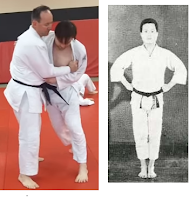
One common application for the mountain block / W-block, first found in Toi-Gye, is an outside-trip throw performed by sliding down the opponent's leg with the "stomp" motion. This is closest to what is called an o soto otoshi in Judo. In Toi-Gye the first W-block follows the "hands-on-waist" position, which may be used to pull in an opponent before the throw.


Source: Freestyle Judo


This throw is a common application for the W-block, and I use it for two other patterns (Sam-Il and Gae-Baek). However, there are a couple other ways to interpret these two movements from Toi-Gye. I will share one below.

Alternative: Thrown then Stomp

An alternative interpretation of these two movements is that the hands-on-waist position is the throw, and the first mountain block is a stomp of your downed opponent. 

We use this application following the opening movement of Toi-Gye as a strike to the opponent's neck.

Inner-forearm block as a striking tool. Source: Traditional Taekwondo Ramblings


Having momentarily stunned our opponent, we put them into a headlock while pulling their arm, also called a chancellery. We turn 180-degrees CCW so that we are facing left, like in the form. From here we can perform a cross-buttocks or hip-wheel throw.
 
Source: Andy Allen demonstrating a cross-buttocks throw from Heian Sandan. Source Video
 
After this throw, you may stomp your downed opponent before disengaging. One example of this, a humerus stomp, is shown by Tom Hill in the gif below:
 
Humerus stomp after a cross buttocks throw. Source: Tom Hill's Karate Dojo
 
The arms of the W-block aren't doing anything in this case, except perhaps providing momentum for the stomp.

Alternative 2: Reverse headlock followed by knee strike


Yet another interpretation of the hands-on-waist position is a reverse headlock while pulling the opponent's right arm.
You may be able to execute this after the reverse punch in the previous step.

From here, it's easy to see how you can use the leg lift for the W-block as a knee strike to the back of the oppoonent, perhaps followed by the W-block as a downward elbow strike or as an attack to the opponent's elbow.

There you go: three applications for the first mountain block in Toi-Gye. Is there one you prefer, or something else?

Saturday, November 2, 2019

35. Sharing some Toi-Gye drawings

These drawings were part of an eBook I abandoned on Toi-Gye. I thought I'd share them here instead. They include throwing and locking applications from parts of the pattern. The two wrist locks shown come from the self-defense (Ho Sin Sul) section of the Encyclopedia of Taekwon-Do.

Opening set

Twin vertical "punch"


Twin elbows and first mountain block.

 The double forearm "pushing block"
Double forearm high block and low knifehand guarding block (three-quarter turn to throw)
The Study of Sam-Il is still available for sale.

Friday, September 7, 2018

21. Toi-Gye "pushing block" mystery


Step 19 of Toi-Gye is not a guarding block. It is officially a "low double forearm pushing block". This motion is weird for a few reasons:
  • The only other kind of "pushing block" is the palm pushing block, which like its name suggests to meant to push the opponent with the palm.
  • This movement appears in no other ITF patterns. It is unique to Toi-Gye.
  • Despite the stated purpose of a "pushing block" being to push the opponent off balance, the only application we ever see for this motion is blocking a kick.
  • Similar motions used to push down an opponent -- such as the low knifehand guarding block -- are usually open-handed. Why the closed fists? And why is the inner-forearm used to block?
I wanted to see where this movement came from. In General Choi's 1965 book Taekwon-Do: The Art of Self-Defense, he lists instructions for several karate kata in addition to the original 20 ITF patterns. The low forearm pushing block appears in two kata: step 10 of Gankaku (which Gen. Choi calls "Ro-Hai" for some reason) and steps 10 and 27 of Tekki Sandan. I looked up youtube performances of the patterns and compared the "pushing blocks".
(Left) Low forearm "pushing blocks" from Toi Gye (left), Genkaku (Middle), and Tekki Sandan (Right). Source: Shotokan Sensei
Neither of these motions look like Toi-Gye. In Genkaku the outer-forearm is used. In Tekki-Sandan the inner-forearm is used, but it's in riding stance and the position of the back arm differs. So as far as I can tell, the motion is unique to Toi-Gye.

Application?

Here I suggest that the use of the name "pushing block" is literal. I know it's common for bunkai researchers to say that the name of the block means nothing, but when a unique motion is used with a unique name, I think we can make an exception

Specifically, we use the pushing block to create a rear wrist lock, a police hold that appears in the Encyclopedia of Taekwon-Do (Volume 5, page 313). We follow with a knee strike to the opponent's lowered head, and then a throw via a head crank.

We begin with the counter-clockwise turning W-block (mountain block), using it to create an armbar.
Source: CentralMichiganTKD
Notice how the tori lands his front leg in front of his opponent's right leg. This is important: we are setting up a trip. The armbar should be a forceful one, utilizing the 180-degree swing we perform in the pattern. This will knock the opponent's shoulder forwards.

As you step in with your left leg, bend your opponent's arm such that their elbow is up, as in a hammerlock. Now you will switch hand positions: grab their left knifehand with your right hand. As you maneuver your arm into the low inner-forearm block, you will naturally curl your opponent's hand and bend their fingers in towards their inner elbow. Make sure to bend their arm behind their back, and grab their elbow with your right hand for control. This creates the rear wrist lock.

(Left) How the low inner-forearm block turns the opponent's wrist. You may bend their fingers towards their elbow. (Right) The rear wrist lock, although the grip in this case is different. Source: Bertoni Defense Systems
Bending the opponent's wrist in causes them to reflexively bend forwards, so you can use both fists to literally push them forwards and to the ground. The direction of the wrist actually pushes them down to the right (towards their elbow), and so when combined with the trip they may fall onto one knee.

If they don't fall, follow the pattern: grab the back of their head with both hands and knee strike their face. Then grab the head with both palms (left hand underneath, right hand on top) and crank it as you turn around into the knifehand guarding block [1], attempting to flip and throw the opponent by their head.

A wrist lock application might seem too esoteric for some, but this is application that both (1) follows the pattern and (2) explains why it is called a "pushing block". This lock also appears in the Encyclopedia of Taekwon-Do, so I'm not pulling it out of nowhere.


[1] A head crank is a common application for the knifehand guarding block. If you move your two palms closer together, then moving from the setup to the block-proper mimicks grabbing and cranking the head.

Wednesday, April 25, 2018

14. Toi-Gye ending: takedown and straight ankle lock

Source: ITFTuls
Lately I have neglected the color belt patterns. So for this post I'm going to discuss the last eight-to-nine steps of Toi-Gye. The set I'll be analyzing is:
  • Front stance high double forearm block
  • Three-quarters turn into low knifehand guarding block
  • Stance shift into left front stance circular block
  • Shift weight into right front stance circular block
  • Step with right leg into riding stance middle punch
  • Ready to closed ready stance C

We begin with the double forearm block followed by the three-quarters turn into the low guarding block. This set has its roots in the end of the kata Pinan Shodan/Heian Nidan, the difference being that the kata uses a closed-fist low block. The application is shown below.
Source: PracticalKataBunkai
In any situation where you can catch your opponent's arm (such as if they have grabbed you), use the back (left) arm of the double forearm block to smash down onto their inner-elbow. Then use the front (right) arm of the "block" to strike the side of their neck. From here, switch hands such that your right arm is grabbing the opponent's elbow. Reach around your opponent's head and pull them to the ground as you turn 270-degrees.

But in Toi-Gye the low block is open-handed, so we cannot grab and pull. Instead, we push from the front. This means that the takedown in Toi-Gye is more similar to the one shown below.
Source: OneMinuteBunkai
After striking with your right arm, press the opponent's right elbow inwards, causing them to lean over counter-clockwise. Then use your left knifehand to check across their face. Finally, from here use the 270-degree turn into the low knifehand guarding block as a throw, maintaining the arm lock with your right knifehand.

The Throw Fails

What if the above throw doesn't work? You try to use the low block as a throw, but you end up just moving your opponent around. Here Toi-Gye takes another page from Pinan Shodan: we follow up with a strike to the side of the opponent's neck. In Pinan Shodan a rising block is used, but in Toi-Gye we use a circular block, which translates into a backfist strike.
Failed low block throw followed by a strike to the side of the opponent's neck. Source: Chris Denwood
Using the circular block as a strike might seem counter-intuitive, but there is good reason to use it as such. A strike is a logical follow-up to a failed throw. Even if the opponent parries it, it distracts them and gives you time to switch to a new technique. The fact that the backfist ends up 45-degrees from our right means that we are striking through our target, which is what we want as this is more damaging. As always, the pulling hand may be used to control the opponent as you strike the side of their neck.

Now for the takedown: we use the second circular block as a leg pick, a more common "deeper" application for the movement. Scoop low, grab and lift the opponent's near (right) leg with our left circular block. Still lifting their leg, we step behind their standing leg into riding stance, and use the riding stance "punch" to push them over our right leg, taking them to the floor.
Circular block to riding stance punch as a takedown. Source: curranskarate
We're not done yet! The last motion in the pattern is the return to ready stance C. We use this to put the opponent into a straight ankle lock -- useful if they try to pull you to the ground with them.
Closed Ready Stance C as a straight ankle lock. Sources: Nick Drossos, Expert Village
Summary

The full set goes as so:
  1. Use the double forearm block to smash on the opponent's inner-elbow while striking their neck
  2. Use the three-quarters turn into low guarding block as a throw
  3. If the throw fails strike the side of the neck with your backfist (first circular block)
  4. If the opponent blocks pick and lift their leg (second circular block)
  5. Step behind their standing leg and push them to the floor (riding stance punch)
  6. Perform a straight ankle lock (closed ready stance C) to put your opponent in pain, allowing you to disengage and run away
Now, Toi-Gye is a symmetric pattern and we practice this set in pieces. This is why you do three circular blocks in a row near the end rather than two. The way I would visualize the movements while practicing Toi-Gye is like so:
  • 30: Double forearm block
  • 31: Turn into a low guarding block as a throw
  • 32: Throw fails, follow with strike to neck
  • 33: Practice low guarding block throw on other side (symmetry)
  • 34: Practice circular block as a strike on other side (symmetry)
  • 35: Practice circular block as a leg pick with right arm
  • 36: Practice circular block as a leg pick with left arm (symmetry)
  • 37: Step into riding stance punch as a throw
  • End: Straight ankle lock

Monday, April 3, 2017

Toi-Gye: What's with the W Blocks?

In the middle of the 7th ITF form, Toi-Gye, there's a baffling bit where you perform six W blocks (also called "Mountain Blocks") in a row. You perform two moving forward, then turn around and perform three, then turn around again and perform the sixth. The way the movements are performed -- lifting your leg and stamping -- is also unusual. You then return to the rest of the form as if nothing happened, but this strange performance of the same move multiple times in a row has left many pattern analyzers scratching their heads about Toi-Gye.

Blocking applications for the W blocks in Toi-Gye
One proposal is that the six W blocks are meant to be a strength exercise. Personally I don't buy this; Gen. Choi provides applications for the movement just like every other move in Toi-Gye (see right image), even if they are the boring block-strike ones. There's no indication that the moves are merely a strength exercise. Instead, I think that the meaning of the blocks become clearer once you break them down into sets.

Set 1: Pull in fists to hip while turning 90-degrees, followed by a W block. A second W block is performed for symmetry
Set 2: Two W blocks, the same set from the karate kata "Jitte". A third W block is performed for symmetry.
Set 3: W block followed by "low pushing block" with left double forearm. This set has no symmetry.

In this post I'll provide applications to each of these three sets, as well as some other uses for the W blocks.

Set 1

Move 12 is performed in slow motion. In patterns a slow motion movement indicates manipulating an opponent's body or resistance, not that you would actually perform the move in slow motion. In this case, pulling both fists to your hips indicates that you are pulling in your opponent -- specifically with your left arm from the reverse punch position in move 11. You turn 90-degrees as you pull, which in a grappling situation will shift your opponent's weight sideways onto one of their legs. This also positions your elbows in line with your hips, like in the form. You then follow by using the W block as a throw, blocking their leg as you pull-push them sideways. Even the stamp is used -- albeit not straight downwards -- to push back the opponent's leg. In Judo this is called a "cross-body o soto gari", a common throw that is difficult to defend against since people have weak lateral balance. An example is shown in the gif below:
Source: Freestyle Judo
So to reiterate:
  • Pulling both fists to your hips represents pulling or "sucking in" your opponent while grappling them
  • Turning 90-degrees as you pull shifts their weight sideways
  • Use the stamping motion to knock back their heavy leg as you throw them with the push-pull motion of the W block
Set 2

This set comes from Jitte. The interpretation I prefer is against a grab and punch. For the first W block, control the opponent's grabbing arm while blocking their punch. Then move in and hammerfist their head with the front arm of the block. You then knee strike (lifting the leg), step behind them, and use the second W block to push and pull them over your leg to throw. An example by Craig Gray (Krav Maga) is shown below; you can find another example by Colin Wee (ITF Taekwondo) here.
Source: Craig Gray
Another use I commonly see for the first W block is to deflect a punch inward. You may then use the second W block as a throw.
Source: Didier Lupo
As for the stamping motion: you could literally stamp in the side or back of the opponent's knee. Your front forearm may be used to either create an armbar or hammerfist the back of your opponent's head.
Source: Beebhatsu R.G.
Set 3

9-7-2018: This interpretation is out of date. See a better one here.

Finally, we turn around again and perform the sixth W block, and then follow with what the Encyclopedia calls a "low pushing block" (najunde miro makgi). I know of a few options for this. The first is that after performing the W block as a simultaneous block and strike to the opponent's face, use your front hand to dig into your opponent's throat, and then forcefully push them to the ground.

The second option is a contingency throw in case our W block throw isn't working. We want to pull our opponent clockwise over our left leg, so to aid this we first step in with our right leg and pull-push them clockwise (setup for low pushing block). We then finish the throw by pushing their torso downward with the low pushing block, although you can feasible dig into their throat instead. Both options are shown in the image below.
Two applications for Toi-Gye 18-19. (Note that row 2 is mirrored).
Source for row 2: monsterprone
A third option for the low pushing block is a strike to the back of the opponent's head after using the W block to create an armbar.

Other Applications for W block

There are two other common applications I see for the W block. The first is a kick defense. You use the back forearm to underhook and the lift your opponent's leg, while stepping behind their standing leg and then pushing them over with your front forearm. One example is shown below:
Source: curranskarate's channel

Source: Fight Fast
The other common application is an arm break or armbar. This is, in fact, one of the first "alternate applications" I ever learned, taught to me by a taekwondoin who cross-trained in American Kenpo. After scouring the internet I finally found a video explaining the technique here. The short of it is that you use the motions of your back and front forearms to forcefully hyperextend your opponent's arm, detaching their bicep. You can find more info by Richard Conceicao (Kukkiwon Taekwondo) here. There is a Kukkiwon form "Keumgang" where you follow this move by turning 180-degrees into an inverted wedging block. This works well as a simple shoulder lock throw, as shown in the two gifs below:


Source: centralmichigantkd
Sources